
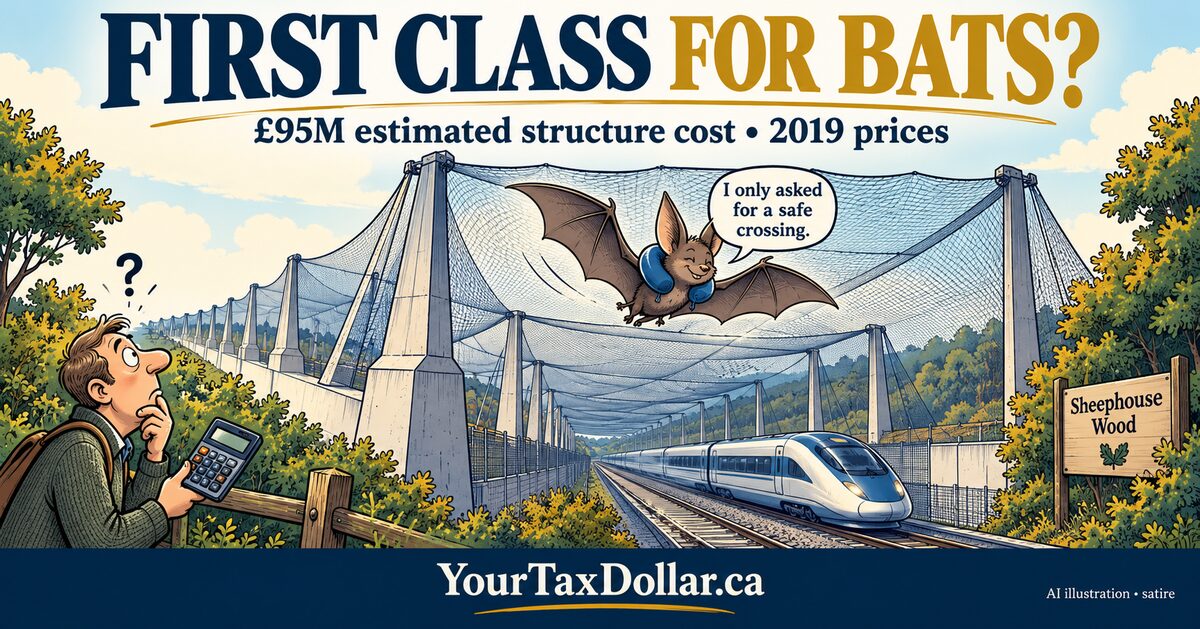
Published October 31, 2026 · Story period: 2025 parliamentary report · costs in 2019 prices
Approximately £95 million estimated structure cost in 2019 prices; HS2 also expresses this as £114 million in 2022 prices. Not a verified final cash-payment total.
The bats did not commission a luxury lounge. Nevertheless, a protective structure beside a British woodland acquired a price tag large enough to make the country stop and stare.
The project is the Sheephouse Wood Bat Protection Structure near Calvert in Buckinghamshire, part of the HS2 railway programme. Its estimated cost is approximately £95 million in 2019 prices. The words after the number matter: this is a cost estimate expressed at a historical price level, not proof that exactly £95 million has already left the public bank account.
HS2 describes an enclosure around 900 metres long, up to 10 metres high and four tracks wide. It has a planned design life of 120 years. Engineering has to account for another railway, difficult surrounding land and the need to avoid taking ancient woodland. HS2 puts the above-ground elements at about £70 million and additional below-ground works at about £25 million, on the same 2019 price basis.
Why build it? HS2’s explanation identifies the surrounding Bernwood Forest landscape as habitat for 13 bat species, including Bechstein’s bat. Frequent high-speed trains create a different risk from the slower, less frequent freight services previously using the area. The protective structure is intended to allow railway operation while reducing harm to protected wildlife.
The Public Accounts Committee was sharply critical in its February 2025 report. It questioned whether the balance between wildlife protection and taxpayer cost was right. Using figures supplied by the Department for Transport, it compared the £95-million structure with £73 million for that stretch of railway without mitigation: a combined £168 million in 2019 prices.
The same report recorded an important distinction about responsibility. HS2 chose the engineering solution; Natural England did not prescribe this particular structure. HS2 and the department said they had considered 15 options and judged the enclosure the most appropriate. Protecting wildlife was an obligation, while the choice of how to meet it still involved decisions open to scrutiny.
Could they simply stop? In a parliamentary answer on March 14, 2025, the government said abandoning the structure would conflict with the conditions for legally operating the railway. It also argued that removing work already built, redesigning the scheme and constructing an alternative would then cost more than completion. That is the government’s stated assessment at that time, not an independent calculation by this website.
Price comparisons need care too. HS2 also expresses its £95-million estimate as £114 million in 2022 prices. A larger number on a different price basis does not, by itself, demonstrate a new cost overrun. Compare the scope, date and assumptions before deciding that a budget has changed.
Our take: protecting wildlife has a legitimate purpose, and taxpayers can still demand a clear account of the alternatives, expected benefits and eventual bill. An explanation of why something is complicated should begin the value-for-money discussion. It should not end it.
What the headline leaves out
This article examines published 2025 explanations and parliamentary scrutiny, rather than reporting a new spending announcement or a completed audit. The structure is national rail infrastructure located in England. Its estimate is not a local council bat budget, and the figures above do not establish final cash paid. We do not calculate a personal taxpayer share from this project estimate.
The roast
The bats didn’t request first class. The infrastructure paperwork apparently did.
Satire. No personal tax share is calculated for this record.
What's your share?
Explore your estimated income tax for this country. This does not mean you personally funded the specific project.
Calculate my tax estimate →